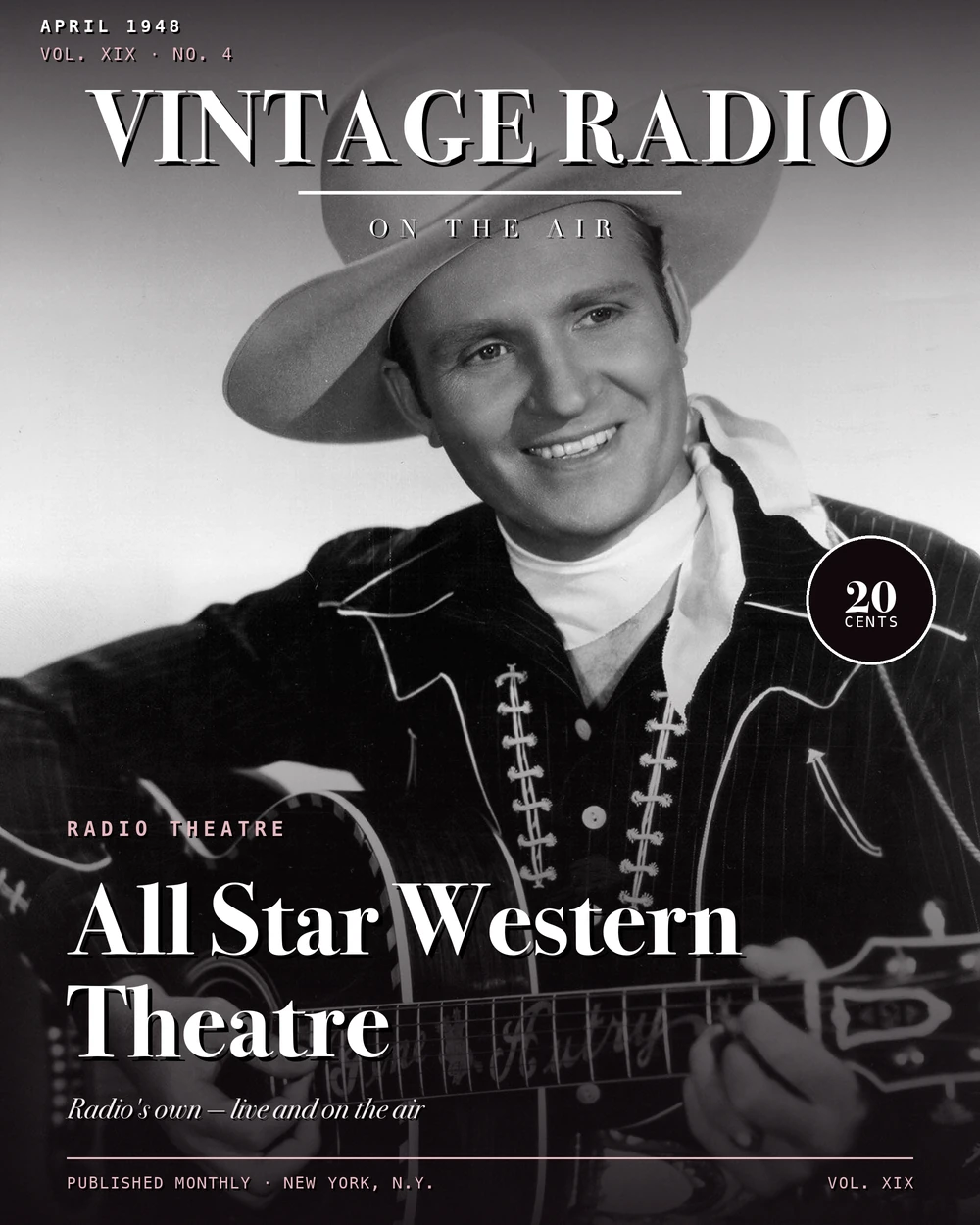
All Star Western Theatre
How It Came Together
All Star Western Theatre didn't start from scratch — it grew straight out of another show. When Gene Autry came home from military service after World War II and reclaimed his Melody Ranch program on CBS, that left Texas-born radio personality Cottonseed Clark without a home. Clark, born Clark Fulks, had been popular enough hosting the Hollywood Barn Dance on CBS since December 4, 1943 that the network didn't want to lose him. The solution was to build him a new vehicle, and that's where All Star Western Theatre came from.
The first broadcast went out on August 11, 1946, with episode one — "Miss East Goes West" featuring Jean Rogers — setting the template for what the show would be. It aired on Sunday afternoons, originating live from Hollywood, with early broadcasts coming out of KNX, the CBS Pacific Network's flagship station at Columbia Square on Sunset Boulevard. By 1948, the show had moved to KHJ and the Mutual/Don Lee Broadcasting System. Weber's Bread sponsored the West Coast run throughout.
Clark served as host and announcer across the show's run. His Texas roots and barn-dance personality gave the program a warm, unpretentious feel — he was a natural fit for a show that leaned into Western authenticity without taking itself too seriously.
Music at the Center
Where All Star Western Theatre differed from most Western radio programming of the era was in what sat at its heart. This was not a drama anthology in the mold of Suspense or Lux Radio Theatre. The show was a musical variety program — each episode built around Foy Willing and the Riders of the Purple Sage performing Western Swing, with guest star appearances, comedy skits, and western stories woven around the music. The dramatic storytelling was real, but it was one ingredient among several, not the whole dish.
Foy Willing — born Foy Lopez Willingham on May 14, 1914, in Bosque County, Texas — co-founded the Riders of the Purple Sage with Iowa musician Al Sloey somewhere between 1942 and 1943. The group played Western Swing, a lively fusion of country, jazz, and blues that was genuinely popular in the 1940s, and the regular band on the show included Kenny Driver, Al Sloey, and Johnny Paul. Willing and the Riders weren't just a radio house band — they appeared regularly on The Roy Rogers Show and The Andrews Sisters' Eight-to-the-Bar Ranch as well, and had been the house band on the Hollywood Barn Dance before All Star Western Theatre existed. Their presence gave the show a consistent musical identity across its entire run.
The group's work here contributed to their wider national reputation. Foy Willing and the Riders of the Purple Sage were inducted into the Western Music Association Hall of Fame in 1991, recognition that came decades after the show had ended but reflected what they'd built during the radio years.
The Guest Stars
One of the program's real draws was its roster of Hollywood talent. Because the show broadcast live from Hollywood and was built around a variety format, it had access to the movie cowboys working in the B-western film industry right there in town, and producers made use of that access consistently.
Named guest stars from the Hollywood western film world include Johnny Mack Brown, Tim Holt, "Wild Bill" Elliott, Tex Ritter, Eddie Dean, Jimmy Wakely, Ken Curtis, and Dale Evans. These were working actors with recognizable names to the show's audience — faces from the Saturday matinee pictures that Western fans already knew. Having them drop by a Sunday afternoon radio show felt like a natural extension of that world.
The show also had room for comedy. Smiley Burnette, Jerry Colonna, and ventriloquist Edgar Bergen — with his dummies Charlie McCarthy and Mortimer Snerd — all appeared on the program, Bergen turning up shortly after Christmas 1947. Mixing that kind of comedy talent into a Western variety hour gave the show a broader appeal than a straight dramatic series would have had.
What Aired and What Survived
The show ran until August 14, 1948, producing somewhere in the range of 94 to more than 100 half-hour episodes across roughly two years. Episode titles give a sense of how the show moved across different kinds of stories and situations: "Buffalo Springs Story," "Texas Adventure," "Gunsmoke," "Cattle Drive to Abeliene," "Windmill on the River," "The Lone Bandit," "Year of Terrible Blizzard," "Miss East Goes West," "Jack, the Joker," "Heaven Is a Star," and "The Varmit and the Baby" all appear in the catalog.
A certified set of 66 circulating episodes out of 78 produced was released on July 7, 2012. That's a reasonably strong survival rate for a regional Sunday afternoon program from this period, and it reflects the care that went into transcribing the broadcasts — the show was recorded in Los Angeles/Hollywood, which made preservation more consistent than it might have been for live-only regional broadcasts elsewhere.
All Star Western Theatre did not make the jump to television when the medium took over American households in the early 1950s. Some episodes reportedly aired as late as 1955 in rerun form, but there was no television successor to the program. The show was specific to radio and to its moment.
Why It Fit Its Era
Cowboys & Indians magazine grouped All Star Western Theatre alongside Gene Autry's Melody Ranch and The Roy Rogers Show as one of the successful radio variety series of the period. That's an accurate frame. The show wasn't trying to do what Gunsmoke or The Lone Ranger did — it wasn't building a mythology around a recurring hero or developing long-term characters over time. What it offered was a reliable weekly hour of Western music, recognizable Hollywood talent, some comedy, and self-contained stories that required nothing from the listener except showing up.
The variety format was well matched to how the show was positioned — Sunday afternoons, a regional Western audience, a sponsor in Weber's Bread with a practical interest in friendly entertainment. Cottonseed Clark holding it together as host, Foy Willing's band providing musical continuity, and a steady stream of B-western film actors as guests gave the program a consistent feel without locking it into any single character or ongoing narrative. For listeners who wanted Western flavor without having to keep track of a serial, it worked exactly as intended.